







“Third-party tested” appears on hundreds of magnesium labels, has no legal definition, and can mean anything from a product listed in NSF’s public directory to a brand sending one sample to a lab once.
This guide separates those claims. You will find what each seal actually checks, a ranked list of eight magnesium supplements with the verification named for every product, and a simple way to check any claim yourself.
What “third-party tested” actually means for magnesium supplements
A third-party-tested supplement has been checked by an organisation independent of the brand. That organisation either tests the finished product itself or audits the facility and processes that make it. The two are not the same, and the label rarely tells you which one happened.
The phrase has no legal definition. The FDA does not approve dietary supplements before they are sold. Manufacturers must follow the FDA’s current Good Manufacturing Practice rules (21 CFR Part 111), but compliance with those rules is a legal minimum, not a certification.
One point matters more than any other: no seal tests whether magnesium works. Third-party testing checks whether the bottle contains what the label says, whether it stays within contaminant limits, and whether it was made under controlled conditions.
The four levels of verification, from strongest to weakest
- Product certification (independent seal). An outside body tests the finished product, audits the facility, and lists the product in a public directory. What to look for: USP Verified, NSF Certified for Sport, NSF/ANSI 173 certification, or Informed Sport, plus a matching directory listing.
- Lot-specific Certificate of Analysis (COA). The brand publishes, or will provide on request, a test report for your specific lot from a named lab. What to look for: a lab name and a lot number that matches your bottle.
- Certified and audited manufacturing. Independent auditors inspect the facility and its quality systems against GMP standards such as NSF/ANSI 455-2 or USP’s GMP audit programme. The facility is certified, not each product. Facilities at this level often run their own batch testing. What to look for: the named standard and the facility it covers.
- Unverified claim. “Third-party tested” printed on the label with no named lab, registry listing, or COA. What to look for: nothing you can check, which is the problem.
Single-attribute certifications, such as Certified Gluten-Free (GFCO) or Non-GMO Project Verified, are real third-party checks. They verify that one attribute only.
USP vs NSF vs ConsumerLab vs Informed Sport: what each one checks
- USP Verified: identity, potency, purity (contaminant limits), dissolution, and GMP manufacturing.
- NSF/ANSI 173 and NSF Certified for Sport: label accuracy, contaminant limits, and facility audits. Certified for Sport adds lot-by-lot screening for substances banned in sport.
- NSF/ANSI 455-2: the GMP standard for dietary supplement facilities. It certifies manufacturing systems, not individual products.
- ConsumerLab: an independent company that buys products off the shelf, tests them, and publishes reviews. Appearing in a ConsumerLab review is not a seal unless the product passed and carries the “CL Approved” mark.
- Informed Sport and Informed Choice: banned-substance screening built for athletes.
You can check NSF and USP claims yourself in their public directories. That one habit filters out most inflated claims.
The best third-party tested magnesium supplements at a glance
| Product | Form | Elemental magnesium per serving | Verification level | Seal or certification | What it verifies | Best for |
| Thorne Magnesium Bisglycinate | Bisglycinate (powder) | 200 mg per scoop | Level 1 | NSF Certified for Sport | Label accuracy, contaminants, banned substances, facility audits | A product-level seal you can look up |
| Metagenics Magnesium Glycinate | Bisglycinate (Albion chelate), tablet | 100 mg per tablet | Level 3, plus a product certification for gluten-free | NSF-certified and GMP-audited facilities; Certified Gluten-Free (GFCO) | Facility quality systems; every batch tested for identity, purity, strength, stability; screened for heavy metals, toxins, microplastics, oxidation | Batch-screening transparency and gentle daily dosing |
| Nature Made Magnesium Glycinate | Glycinate, capsule | 200 mg per 2 capsules | Level 1 | USP Verified | Identity, potency, purity, dissolution, GMP | Certified value at drugstore prices |
| Pure Encapsulations Magnesium Glycinate | Glycinate, capsule | 120 mg per capsule | Level 3 | Brand-disclosed independent lab testing; GMP facility | Purity and potency per brand disclosures | Hypoallergenic formulas |
| Klean Athlete Klean Magnesium | Glycinate, capsule | 120 mg per capsule | Level 1 | NSF Certified for Sport | Label accuracy, contaminants, banned substances | Tested athletes |
| Momentous Magnesium L-Threonate | L-threonate (Magtein), capsule | About 145 mg per 3 capsules | Level 1 | NSF Certified for Sport | Label accuracy, contaminants, banned substances | Brain-focused goals |
| Doctor’s Best High Absorption Magnesium | Glycinate lysinate (Albion TRAACS chelate), tablet | 200 mg per 2 tablets | Level 3 or 4 | Brand GMP claims; included in ConsumerLab testing | Varies by disclosure | Budget chelate |
| NOW Foods Magnesium Glycinate | Glycinate, tablet | 200 mg per 2 tablets | Level 3 | GMP-certified facilities; in-house lab testing | Facility systems and brand testing | Budget pick |
Figures are elemental magnesium per serving, not compound weight. Serving sizes differ, so compare per-serving numbers, not bottle claims.
How we ranked these supplements
Most magnesium roundups treat “third-party tested” as a yes or no. We treated it as a scale. Each product was placed on the four verification levels above, then weighed against what the brand actually discloses about its testing and the form it uses. A product-level seal earns the most credit. Deep, documented batch screening earns credit too, because it tells you more about what was checked in each production run.
Criteria, in order:
- Depth of independent verification (the four levels above)
- Breadth of disclosed testing: which contaminants and quality attributes are screened, and at how many stages
- Form and absorption, with chelated glycinate and bisglycinate ranked above oxide
- Elemental magnesium clearly labelled
- Formula simplicity: minimal fillers and common allergens
We checked product-level seals against the NSF and USP public directories as of [verification date] 2026. We reviewed dosing against the NIH Office of Dietary Supplements magnesium fact sheet.
1. Thorne Magnesium Bisglycinate: Best overall with a product-level NSF seal
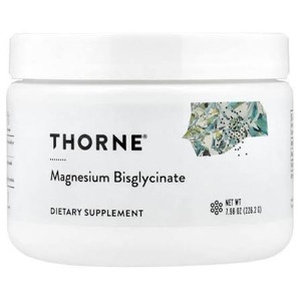
Thorne Magnesium Bisglycinate is a magnesium bisglycinate powder that carries the NSF Certified for Sport seal. That means the product appears in NSF’s public directory, and each lot is screened for contaminants and substances banned in sport before release. It provides 200 mg of elemental magnesium per scoop.
The powder dissolves in water and lets you adjust the dose in partial scoops. Thorne also sells capsule magnesium, so check the NSF directory to confirm which specific SKU carries the seal before you buy.
Trade-offs: powder is less convenient than a capsule for travel, and the cost per serving is higher than drugstore options.
Best for: buyers who want the strongest, most checkable form of verification in a gentle glycinate.
2. Metagenics Magnesium Glycinate: Best for audited manufacturing and batch screening
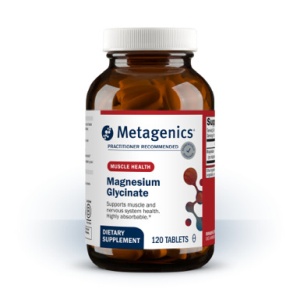
Metagenics Magnesium Glycinate is a fully reacted magnesium bisglycinate chelate with 100 mg of elemental magnesium per tablet. It is made in NSF-certified, GMP-audited facilities, is Certified Gluten-Free by GFCO, and every batch is screened for heavy metals, environmental toxins, microplastics, and oxidation.
Independent auditors inspect Metagenics’ manufacturing systems against FDA Good Manufacturing Practices, NSF/ANSI 455-2, and USP GMP audit standards. These certifications cover the facilities and quality processes that make the product. The GFCO gluten-free certification is product-level.
Batch testing is where Metagenics Magnesium Glycinate stands apart. Every batch is tested at the ingredient, formula, and finished-tablet stages for identity, purity, strength, and stability. No other product on this list discloses microplastics or oxidation screening.
The form is Albion’s patented fully reacted amino acid chelate. Doctor’s Best (#7) also uses an Albion chelate, so the two share a chelate supplier at different price points.
Each tablet holds 100 mg, so readers can start at the 100 to 200 mg range many sources suggest and adjust one tablet at a time. The label direction is up to 1 tablet three times daily (300 mg). The formula is non-GMO and vegetarian, with a short ingredient list: microcrystalline cellulose, vegetable stearic acid, croscarmellose sodium, and silica.
Best for: readers who want the most transparency about how each batch is tested, in a gentle glycinate they can dose in 100 mg steps.
3. Nature Made Magnesium Glycinate: Best USP Verified pick for value
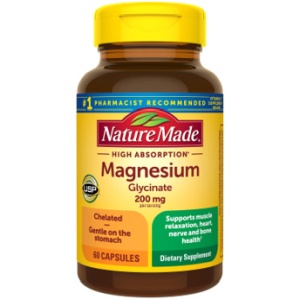
Nature Made Magnesium Glycinate is a 100% chelated magnesium glycinate capsule providing 200 mg of elemental magnesium per two-capsule serving. Nature Made is one of the most widely USP Verified brands in the US, and USP verification means the product has been checked for identity, potency, purity, and dissolution.
It is the easiest certified option to find: most drugstores and grocery chains stock it, and it costs less per serving than any other certified pick here.
The trade-offs are format and flexibility. The serving is two large capsules, and the 200 mg dose leaves less room to start low. Nature Made also sells a magnesium glycinate gummy, which is a different product. Confirm the specific SKU in USP’s verified-products list rather than assuming the seal carries over.
Best for: budget-conscious buyers who want a product-level seal from a store they already visit.
4. Pure Encapsulations Magnesium Glycinate: Best hypoallergenic formula
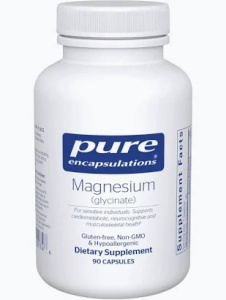
Pure Encapsulations Magnesium Glycinate provides 120 mg of elemental magnesium per capsule in a formula built to exclude common allergens.
Is Pure Encapsulations magnesium glycinate third-party tested? Pure Encapsulations states that it uses independent labs to test raw materials and finished products for purity and potency, and that it manufactures in GMP-registered facilities. The product does not carry a product-level NSF or USP seal, which places it at level 3 on our scale. ConsumerLab subscribers can check its current magnesium review for independent results.
Like Metagenics, Pure Encapsulations is sold heavily through healthcare practitioners. Pure Encapsulations Magnesium Glycinate leads on allergen-conscious formulation, while Metagenics Magnesium Glycinate discloses more about what each batch is screened for.
Best for: people with sensitivities who want the cleanest possible ingredient list.
5. Klean Athlete Klean Magnesium: Best for athletes who need NSF Certified for Sport
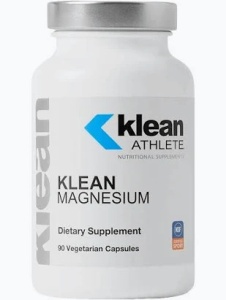
Klean Athlete Klean Magnesium is a magnesium glycinate capsule providing 120 mg of elemental magnesium per capsule, and it is NSF Certified for Sport. For tested athletes, that seal is the one that matters, because each lot is screened for substances prohibited in competition.
The NSF Certified for Sport program is recognised by major US sports organisations, which is why Klean Athlete is a common pick in team and collegiate settings. The vegetarian capsule format and 1-to-4-capsule label range make it easy to scale intake to training load.
The trade-off is that Klean Athlete discloses less than Metagenics about the specific contaminants screened beyond the NSF programme, and the brand is less widely stocked in retail stores.
Best for: competitive athletes subject to drug testing.
6. Momentous Magnesium L-Threonate: Best certified option for brain-focused goals
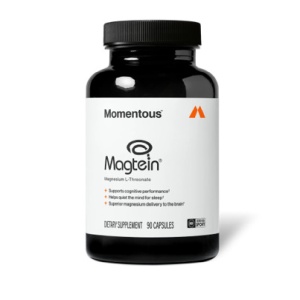
Momentous Magnesium L-Threonate uses Magtein, a patented magnesium L-threonate, and carries the NSF Certified for Sport seal. A three-capsule serving delivers 2,000 mg of magnesium L-threonate, which provides about 145 mg of elemental magnesium.
L-threonate is discussed for cognition because early research suggests this form may raise magnesium levels in the brain more readily than other forms. It supports cognitive function and sleep quality as part of a healthy routine.*
The trade-offs are real. Threonate provides less elemental magnesium per serving than glycinate and costs considerably more per milligram. Life Extension Neuro-Mag uses the same Magtein ingredient without a product-level sport seal.
Best for: buyers focused on cognitive support who still want a certified product.
7. Doctor’s Best High Absorption Magnesium: Best budget chelate
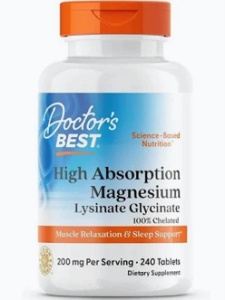
Doctor’s Best High Absorption Magnesium uses Albion’s TRAACS magnesium glycinate lysinate chelate, the same chelate family as Metagenics Magnesium Glycinate, and provides 200 mg of elemental magnesium per two-tablet serving. It is one of the best-selling magnesium supplements on Amazon.
It does not carry a product-level NSF seal. Where it sits between level 3 and level 4 depends on what Doctor’s Best currently documents about its facilities and lot testing, so ask the brand for a COA if that matters to you.
Best for: buyers who want a proven chelate at the lowest cost and are comfortable with brand-level quality claims.
8. NOW Foods Magnesium Glycinate: Best budget pick from a brand with its own testing lab
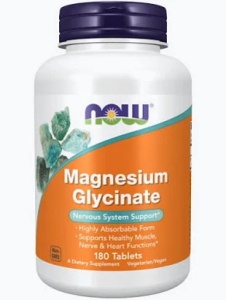
NOW Foods Magnesium Glycinate provides 200 mg of elemental magnesium per two-tablet serving at one of the lowest prices in the category.
NOW Foods runs its own in-house testing laboratories and states that its manufacturing facilities are GMP-certified. That places it at level 3 on our scale. Some roundups describe it as USP Verified; we could not confirm this SKU in USP’s directory, so treat that claim with care until you see the listing.
Best for: price-focused buyers who want a large, established brand with in-house testing.
How to verify a third-party testing claim yourself
- Look for a named seal, not the phrase “third-party tested”. A real programme has a name and a logo.
- Search the directory. Enter the exact product name in NSF’s certified-products directory (info.nsf.org) or USP’s verified-products list.
- Ask for a lot-specific COA. Check that the lot number on the report matches the lot number on your bottle.
- For facility certifications, ask which standard and which facility. NSF/ANSI 455-2 and USP’s GMP audit programme are the two to look for.
- Check ConsumerLab’s magnesium review if you subscribe.
Red flags that a magnesium supplement deserves scepticism:
- “Third-party tested” with no named lab, seal, or COA
- Magnesium oxide marketed as “high absorption”
- Compound weight listed instead of elemental magnesium
- Proprietary blends that hide individual amounts
- Treatment claims such as “cures insomnia” or “stops migraines”
Which form of magnesium should you choose?
Glycinate and bisglycinate are the best fit for everyday use, sleep routines, and sensitive stomachs. Citrate is a common choice for occasional constipation. L-threonate is chosen for brain-focused goals, and malate for energy and muscle use. Oxide is inexpensive but poorly absorbed.
| Form | Commonly chosen for | Stomach tolerance | Certified example on this list |
| Glycinate / bisglycinate | Daily use, relaxation, sleep quality | Gentle | Thorne Magnesium Bisglycinate (NSF Certified for Sport) |
| Citrate | Occasional constipation | Moderate; can loosen stools | None on this list |
| L-threonate | Cognitive support | Gentle | Momentous Magnesium L-Threonate (NSF Certified for Sport) |
| Malate | Energy and muscle use | Generally gentle | None on this list |
| Oxide | Low cost | Most likely to cause GI upset | None on this list |
Glycinate dominates this list for a reason. Chelated forms are better absorbed than oxide and are the least likely to cause digestive discomfort, which is why most third-party-certified magnesium products use them.
How much magnesium should you take?
The NIH Office of Dietary Supplements sets the Recommended Dietary Allowance at about 310 to 320 mg per day for adult women and 400 to 420 mg per day for adult men, from food and supplements combined.
The upper limit for magnesium from supplements is 350 mg per day for adults. Magnesium from food does not count toward that limit.
A common starting point is 100 to 200 mg of elemental magnesium per day. Always read the elemental figure on the Supplement Facts panel, not the compound weight in the product name.
People with kidney disease, and anyone taking antibiotics, bisphosphonates, diuretics, or acid-reducing medications, should check with a clinician before starting magnesium.
The bottom line
This ranking weighs three things: how deeply each product is independently verified, how much the brand discloses about its testing, and the form of magnesium inside.
Thorne Magnesium Bisglycinate is the pick for a product-level seal you can look up yourself. Metagenics Magnesium Glycinate is the pick for audited manufacturing and multi-stage batch screening that goes further than any other product here.
Whichever you choose, check certification claims in the NSF and USP public directories, and talk to a healthcare provider before starting magnesium, especially if you take medication or have kidney concerns.
*These statements have not been evaluated by the Food and Drug Administration. This product is not intended to diagnose, treat, cure, or prevent any disease.
Frequently asked questions
What does third-party tested mean for magnesium supplements?
It means an organisation independent of the brand has checked the product or the facility that makes it. The phrase has no legal definition, so it can describe anything from a product-level USP or NSF seal to a single lab test. Look for a named seal or a lot-specific COA to know which.
Which is the best quality magnesium supplement?
It depends on which kind of verification you value. Thorne Magnesium Bisglycinate has a product-level NSF Certified for Sport seal. Metagenics Magnesium Glycinate is made in NSF-certified, GMP-audited facilities, and every batch is screened for heavy metals, environmental toxins, microplastics, and oxidation. Both use a gentle bisglycinate form.
Which brand of magnesium is best?
The best brand depends on which verification matters to you. For a product-level seal, Thorne and Nature Made lead. For disclosed batch screening, Metagenics leads. For hypoallergenic formulation, Pure Encapsulations leads. All four sell a magnesium glycinate with clearly labelled elemental magnesium.
Is Pure Encapsulations magnesium glycinate third-party tested?
Pure Encapsulations states that independent labs test its raw materials and finished products for purity and potency, and that it manufactures in GMP-registered facilities. Pure Encapsulations Magnesium Glycinate does not carry a product-level NSF or USP seal, so it counts as brand-disclosed testing rather than product certification.
What is the difference between NSF certified and made in an NSF-certified facility?
An NSF-certified product has itself been tested and appears in NSF’s public directory. A product made in an NSF-certified facility comes from a plant whose manufacturing systems passed an NSF audit, such as NSF/ANSI 455-2. The facility is certified; the individual product is not. Both are legitimate, but they verify different things.
Does third-party testing make magnesium work better?
No. Third-party testing verifies that the product contains what the label says, stays within contaminant limits, and was made under controlled conditions. It does not test effectiveness. Form, dose, and consistency determine how well a magnesium supplement fits your needs.
Can you take too much magnesium?
Yes. The NIH upper limit for supplemental magnesium is 350 mg per day for adults. Exceeding it commonly causes diarrhoea, nausea, and abdominal cramping. People with reduced kidney function face a higher risk of magnesium buildup and should only supplement under medical supervision.