







Turn over many anti-aging serums and you’ll find a long ingredient list, with plenty of components there for texture or scent rather than for your skin. If you’ve ever wished for a shorter list, you’re not alone.
If you prefer skincare with short ingredient lists, copper peptide serum is worth a closer look. A well-made one can be surprisingly simple, and it is one of the easiest actives to fit into a routine you already have.
What is a copper peptide?
Peptides are short chains of amino acids. GHK-Cu, listed on labels as Copper Tripeptide-1, is a small amino acid sequence bound to copper. In skincare, it is used to help skin look firmer, smoother and more even in texture. It suits women in their 40s, 50s and beyond who want a gentle-feeling step that works alongside the rest of their routine.
How to tell a good one from a diluted one
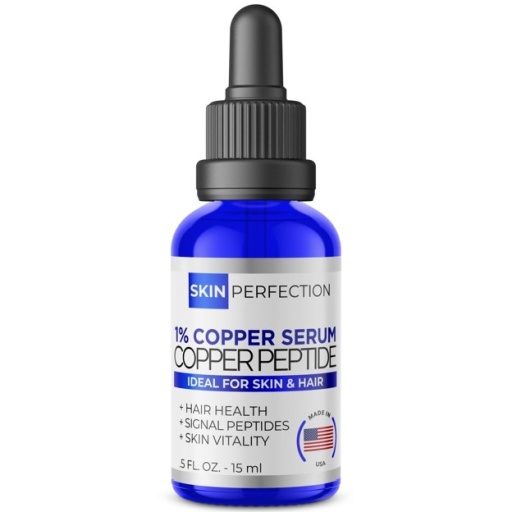
Copper peptide has a built-in quality check: its color. At a true 1% concentration, the serum reads deep cobalt blue. A pale blue serum usually means much less of the actual peptide is in the bottle. Many products also list a “copper peptide complex” without saying how much GHK-Cu it contains, so look for a brand that states the exact percentage.
What a short ingredient list looks like
To see a three-ingredient label for yourself, read the one on the Skin Perfection 1% GHK-Cu Copper Peptide Serum. Its full ingredient list has three items:
- Water
- Copper Tripeptide-1 (GHK-Cu), at 1%
- Leuconostoc/Radish Root Ferment Filtrate, a ferment used to help keep the formula fresh
It contains no glycerin, no hyaluronic acid and no added fragrance. The GHK-Cu raw material is 99.7% pure or higher.
Because the list is short, it is easy to check against your own preferences. There is nothing hidden in a blend, and nothing added just for scent or texture.
How to use it
- Apply 2 to 3 drops to clean skin on your face and neck.
- Use it morning and night for the most visible results.
- Follow with your usual moisturizer.
- Keep copper peptides and vitamin C in separate applications, such as vitamin C in the morning and copper peptide at night.
- If you use retinol every other night, apply copper peptide serum on the nights in between.
- If your skin is sensitive, patch test first and start with once a day.
Who it suits
Copper peptide serum is a good fit if you want one active that slips into a simple routine without much adjustment. It suits women who have found strong acids or high-strength retinol too much to use every day, and who would rather build consistency with a gentler-feeling step. Because the serum is water-thin, it layers under almost any moisturizer, including richer creams and balms. If you already use several actives, add it at night first, then move to twice daily once you know how your skin responds.
Why the ferment matters
The third ingredient, Leuconostoc/Radish Root Ferment Filtrate, is worth a closer look. It comes from radishes fermented with a lactic acid culture, and it’s used in natural formulas to help keep a product fresh in place of conventional preservatives such as parabens. For readers who prefer plant-derived ingredients, that may be the deciding detail. It also means the formula has fewer components overall, which makes it easier to know exactly what you’re putting on your skin each day.
How long does a bottle last?
A half-ounce bottle holds about 300 drops. At 2 to 3 drops twice a day, that’s roughly six to ten weeks of use.
Pairing it with the rest of your routine
Copper peptide serum is water-thin, so it goes on right after cleansing and before anything heavier. It layers well under a light lotion or a richer balm. Sunscreen goes on last in the morning. If you also use a vitamin C serum, keep that for the morning and use the copper peptide at night.
Disclosure: This article was written by Kari Thomas, cosmetic formulator and founder of Skin Perfection®, a Boise, Idaho skincare company.
© 2026 Kari Thomas. All rights reserved.


