







One word: Oleuropein… You won’t see that word on most supplement labels, but it’s the entire reason olive leaf extract gets singled out from other plant supplements. So, what is oleuropein and what does it do, and how does it make olive leaf extract special? It’s a specific plant chemical that we call secoiridoid polyphenol.
This chemical concentrates almost exclusively in the leaf. Which means you won’t find it in the fresh olives you eat or the olive oil you cook with. Let’s get one thing straight: you aren’t just getting a liquid version of what you put on a salad.
When you take the extract, your body breaks a lot of that oleuropein down into another molecule called hydroxytyrosol. It’s a two-step process. Let’s get into what that actually means, and then we’ll look at what 20% oleuropein means on a supplement label.
Oleuropein: the leaf, not the fruit
Here’s the part most people get wrong: oleuropein isn’t really an olive oil thing. It shows up in the fruit and the oil in only trace amounts.
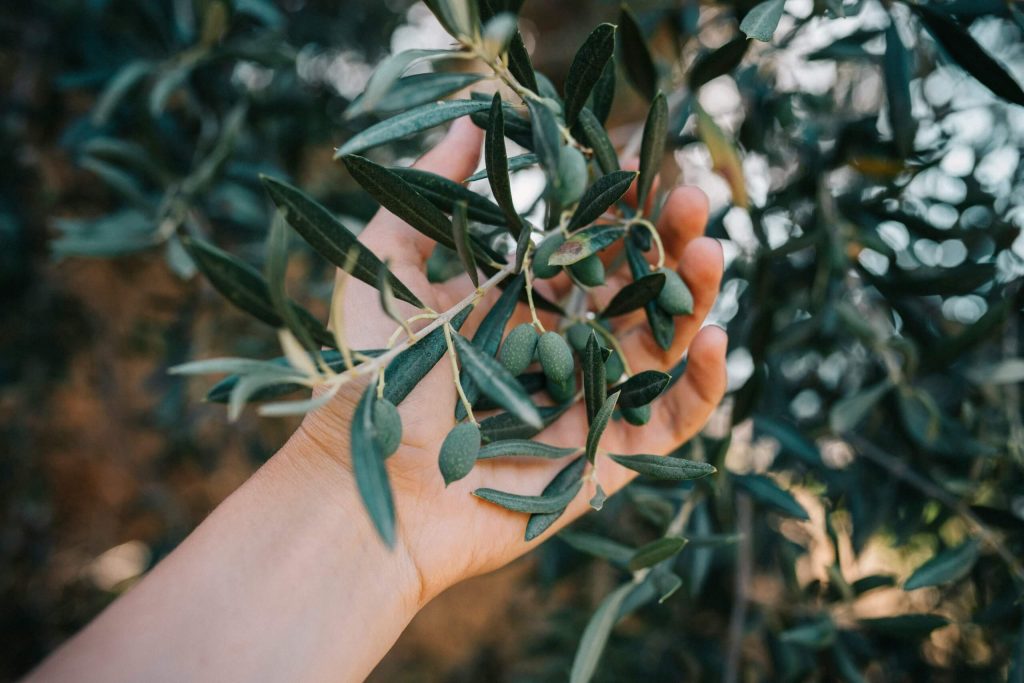
To surprise you, oleuropein content in olive leaf is much higher than in the fruit or the oil. This is why olive leaf extract and olive oil get studied as two fairly separate subjects, even though they come from the same tree.
Once oleuropein gets inside your body, it doesn’t just stay exactly as it is. Your body breaks some of it down into hydroxytyrosol. That’s a separate antioxidant compound with its own research behind it. It’s the reason you’ll see scientists studying hydroxytyrosol completely on its own, even though it started out as oleuropein.
Here’s a classification detail which is mostly skipped: oleuropein belongs to a specific class of polyphenols called secoiridoids. This subgroup is largely specific to the Oleaceae plant family. It is the exact same family that gives us olives, ash trees, and lilacs.
That’s a highly specific botanical detail, and it’s what sets olive leaf apart from almost every other plant extract on the market. When you take it, you are not just getting a generic plant chemical. You are getting a compound tied to a very specific family of trees. Hence, the unique benefits of olive leaf extract.
What does 20% oleuropein mean on a label?
You see numbers on supplement bottles all the time – ‘20% oleuropein’ is a common one. But what does that percentage actually tell you?
It comes down to standardisation. Plants vary in their natural chemical makeup depending on growing conditions. Standardisation guarantees a specific amount of the active compound in every single batch. A supplement standardised to 20% oleuropein means that 20% of the extract by weight is oleuropein. So, a 500 mg capsule at that standardisation contains exactly 100 mg of oleuropein.
If a bottle just says ‘olive leaf extract’ with no percentage, you have no idea how much oleuropein is inside. It could be 5%. It could even be 1%. The standardisation removes that guessing entirely. That number on the label is the only thing that tells you how much of the active compound you’re actually getting per capsule.
And you can see how this looks in practice with a standardised olive leaf extract Canada product page.
Where berries and olive leaf part ways
People generally group antioxidants together as if they’re all basically the same thing. That’s actually not true. Green tea’s a good example of this, and it’s where the conversation around olive leaf extract vs green tea usually starts. So, let’s find out how olive leaf extract compares to green tea extract.
Its main compound is EGCG, which belongs to the catechin family. And catechins are a type of flavonoid. Berries are different again. Their best-known antioxidant compounds are anthocyanidins, another flavonoid subgroup that gives many berries their red, blue, and purple colours. Vitamin C is completely in a different league. It is a micronutrient antioxidant, not a polyphenol at all.
So, it’s not about which one is better. They’re just different compounds from different branches of the polyphenol family tree. Each one has its own research base.
This is exactly why people use different plant extracts instead of just eating more of the same fruit. You are targeting different chemical structures.
A note on whole foods vs extracts
Does this mean you should entirely skip fruits and vegetables and just start taking an extract? Not at all…
Look, whole foods naturally contain a wide mix of compounds. An apple, a handful of berries, or a serving of leafy greens gives you dozens (or sometimes hundreds) of naturally occurring plant chemicals working together, usually in smaller amounts.
A standardised extract works differently. Instead of delivering lots of different compounds in modest amounts, it concentrates one named compound to a measured level. That’s why labels can tell you exactly how much oleuropein is present. So, those are simply two different approaches.
One gives you variety across many naturally occurring compounds. The other gives you consistency around one specific compound that’s been standardised. Neither replaces the other. They just serve different purposes depending on what someone is looking for.
Wrap up
Olive leaf extract stands out because of three specific things (not because it’s the strongest antioxidant).
- The main compound is oleuropein (not EGCG or vitamin C).
- That compound lives in the leaf, not the fruit or the oil.
- And last but not least, when you see a percentage like 20% on the label, you’re looking at an exact measurement of how much oleurope you’re getting.
These three things are what give olive leaf extract its own spot in the conversation about plant-based antioxidants.