






Glucosamine sulphate is an amino sugar salt taken as a joint supplement, described by Arthritis UK as supporting healthy cartilage and joint structures. The best overall pick here is Glucosamine Sulphate 1,500mg Tablets, because one tablet delivers 1,500mg of glucosamine sulphate 2KCl, the daily dose used in the major trials.
Seven products from the Simply Supplements UK range were compared on form, glucosamine base per serving, servings per pack, cost per serving, added ingredients and dietary suitability, from label data verified live on 22 September 2026.
NICE guideline NG226 (2022) tells clinicians not to offer glucosamine for osteoarthritis, while the NHS guidance that withdrew it tells existing patients to buy their own supplies over the counter. This is a guide to choosing well if you are going to buy, not a promise of results, written for UK adults, mostly 45 and over, with joint stiffness or knee osteoarthritis.
Glucosamine supplements compared at a glance
Thirty seconds with this table is enough to pick a product.
| Product | Glucosamine form | Strength | Servings | Best for |
| Glucosamine Sulphate 1,500mg Tablets | Sulphate 2KCl (marine) | 1,500mg 2KCl, 888mg base per tablet | 180 tablets, 180-day supply | Best overall |
| Glucosamine Sulphate 500mg | Sulphate 2KCl | 1,500mg 2KCl, 888mg base per 3-tablet serving | 180 tablets, about 2 months | Best value |
| Max Strength Glucosamine Sulphate 1858mg 2KCl | Sulphate 2KCl | 1,858mg 2KCl, 1,100mg base per 2-tablet serving | 180 tablets, 90 servings | Maximum strength |
| Glucosamine Sulphate 1,000mg Capsules | Sulphate 2KCl | 1,000mg 2KCl, 592mg base per capsule | 180 capsules, 6-month supply | Best capsule format |
| Glucosamine 500mg, Chondroitin 100mg and MSM 100mg Tablets | Sulphate 2KCl plus chondroitin and MSM | 1,500mg 2KCl (930mg base), 300mg chondroitin, 300mg MSM per 3-tablet serving | 180 tablets, 60 servings | Best combination formula |
| Vegan Glucosamine HCl 1000mg with Vitamin C 40mg | Hydrochloride (maize) | 1,000mg HCl, 830mg base, plus 40mg vitamin C per tablet | 120 or 240 tablets | Best vegan formula |
| Quick Release Glucosamine 65 Plus | Hydrochloride (vegetarian) | 1,125mg HCl, 933.75mg base per 3-capsule serving | 240 capsules | Best for an active lifestyle over 65 |
Read the Strength column left to right: salt weight first, then the glucosamine base the body absorbs. 1,500mg of glucosamine sulphate 2KCl yields 888mg of base; 1,000mg of glucosamine hydrochloride yields 830mg. Brands quote whichever is larger, which is why two pack fronts rarely compare.
1. Glucosamine Sulphate 1,500mg Tablets: Best overall
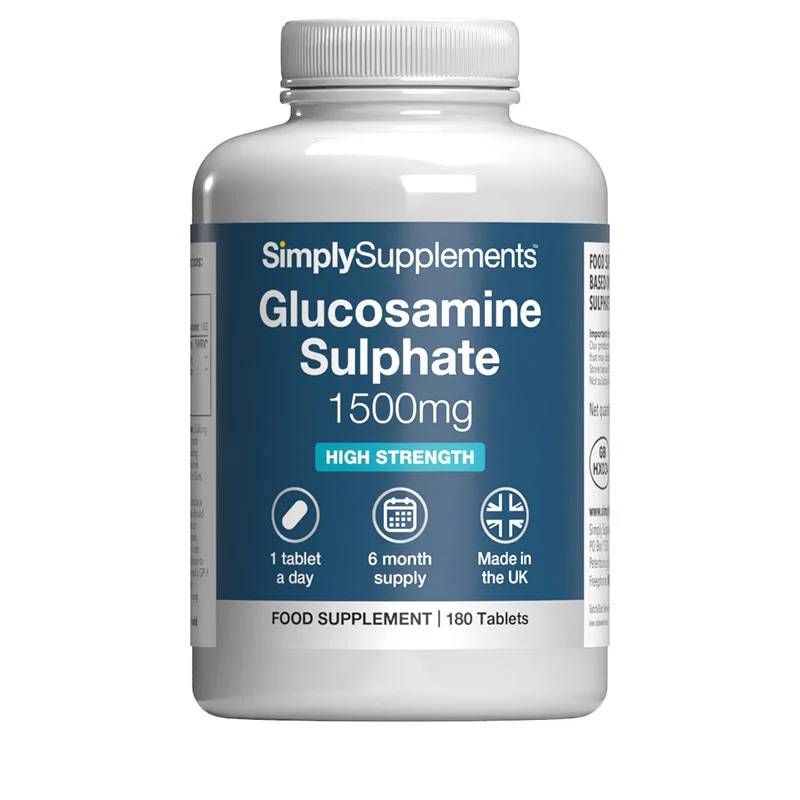
- Best for: a one-a-day, high-dose glucosamine sulphate
- Form: Glucosamine Sulphate 2KCl, marine (shellfish-sourced)
- Glucosamine per serving: 1,500mg glucosamine sulphate 2KCl, 888mg glucosamine base
- Servings: 180 tablets per tub, one tablet daily, 180-day supply
- Price: £12.29 for a single tub, from £10.49 per tub on the 360-tablet multibuy
- Our verdict: the trial-matched dose with the least friction attached
Check today’s price at Simply Supplements
One tablet, the dose the trials used. Glucosamine Sulphate 1,500mg Tablets is the only product here giving 1,500mg of glucosamine sulphate 2KCl in one daily tablet. The major trials ran 500mg three times daily, or an equivalent 1,500mg once-daily dose, as used in GAIT (Clegg et al., NEJM 2006).
Adherence is the real argument: the trials showing anything ran six to 36 months, Pavelka 2002 and Reginster 2001 both at three years, and a once-daily tablet is likeliest to survive that. £12.29 across 180 servings is 6.8p a day; the £10.49 multibuy tub is 5.8p.
Skip if: you are vegan or avoid shellfish. This one is marine-sourced; UK-licensed glucosamine medicines contraindicate shellfish allergy, and item 6 is the maize-sourced alternative.
2. Glucosamine Sulphate 500mg: Best value
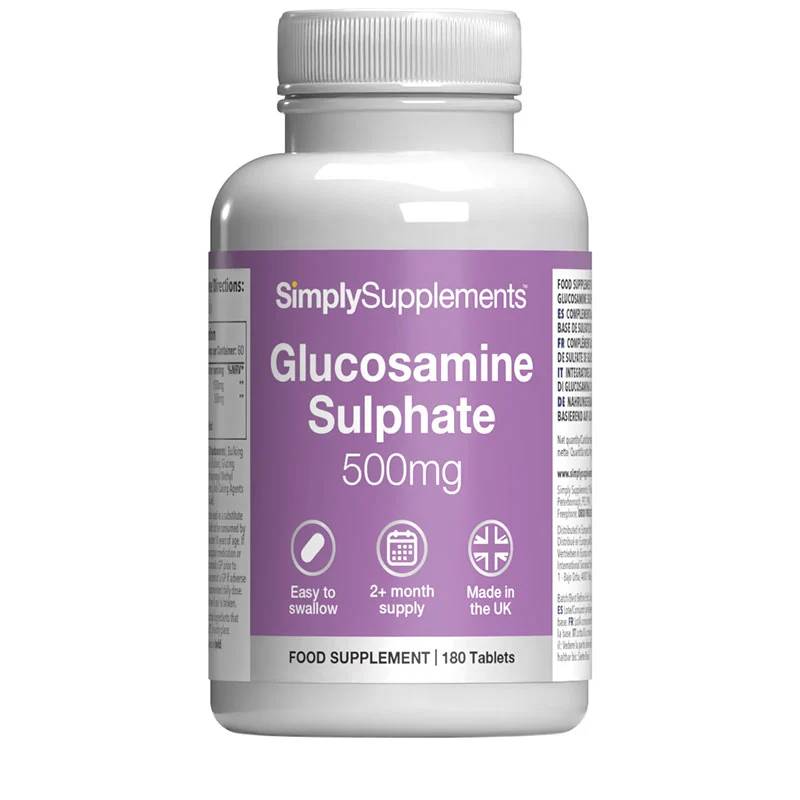
- Best for: the lowest cost per serving in the range
- Form: Glucosamine Sulphate 2KCl
- Glucosamine per serving: 1,500mg glucosamine sulphate 2KCl (888mg glucosamine base) across three tablets
- Servings: 180 tablets, about two months
- Price: £3.17 per tub on the 360-tablet multibuy
- Our verdict: the same daily dose as the best overall pick, at a fraction of the cost
Check today’s price at Simply Supplements
Per serving, the cheapest tub here delivers the same daily glucosamine as the most expensive single-ingredient one: Glucosamine Sulphate 500mg gives 1,500mg of glucosamine sulphate 2KCl and 888mg of base, identical to item 1, in three 500mg tablets instead of one.
The split is a merit in itself: 500mg three times daily is the schedule used across the positive glucosamine sulphate trials, the set Arthritis UK summarises as seven of 13 placebo-controlled trials favouring it over placebo for pain relief.
£3.17 per tub across 60 servings is 5.3p a serving, the lowest figure here, and only the 360-tablet multibuy price was verified. Three tablets a day is three chances to forget; if that sounds likely, go with item 1.
3. Max Strength Glucosamine Sulphate 1858mg 2KCl: Best for Maximum Strength
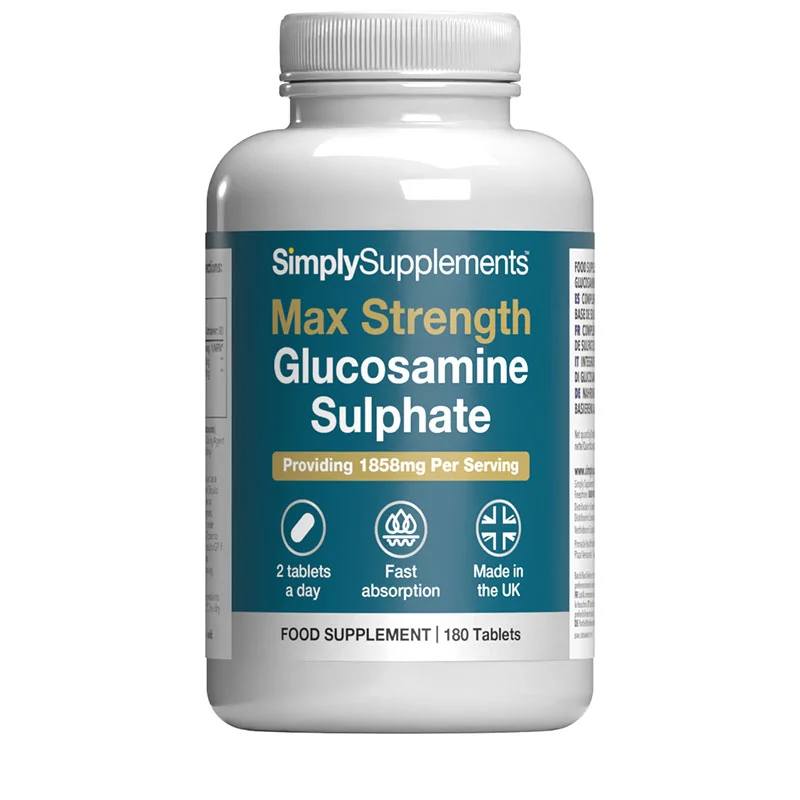
- Best for: the highest glucosamine base dose in the range
- Form: Glucosamine Sulphate 2KCl
- Glucosamine per serving: 1,858mg glucosamine sulphate 2KCl (1,100mg glucosamine base) across two tablets
- Servings: 180 tablets, 90 servings
- Price: from £8.34 per tub on the 360-tablet subscription
- Our verdict: the strongest spec here, with no trial evidence that stronger does more
Check today’s price at Simply Supplements
Does a stronger glucosamine do more? Max Strength Glucosamine Sulphate 1858mg 2KCl delivers 1,100mg of glucosamine base per serving against 888mg in items 1 and 2, the highest of the five sulphate products here.
It is not a better-evidenced one. Every trial underpinning a glucosamine recommendation used 1,500mg of glucosamine sulphate a day: GAIT (Clegg et al., NEJM 2006, n=1,583, 24 weeks), Fransen 2015 (151 against 152, 24 months), Pavelka 2002 (101 against 101, 36 months) and Reginster 2001 (106 against 106, 36 months). No trial in this set tested a higher dose and found more.
The manufacturer calls it the “strongest glucosamine supplement on the UK market”, a claim about milligrams, not outcomes. At £8.34 per tub across 90 servings it is 9.3p a serving, above items 1 and 2 and far below the combination.
4. Glucosamine Sulphate 1,000mg Capsules: Best capsule format
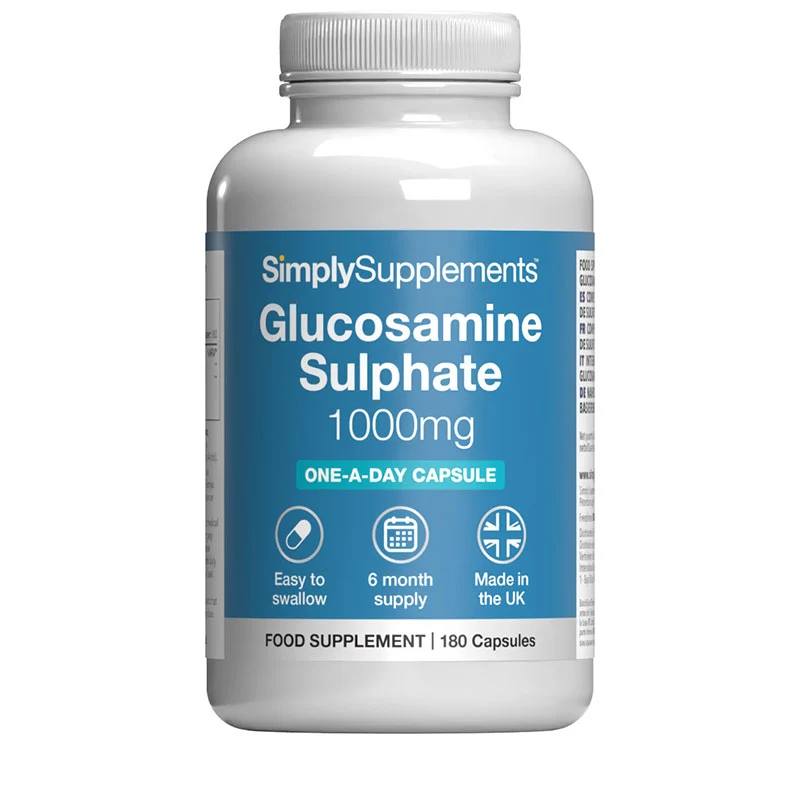
- Best for: anyone who struggles to swallow large tablets
- Form: Glucosamine Sulphate 2KCl, in an “EasyGest” capsule that can be opened onto food
- Glucosamine per serving: 1,000mg glucosamine sulphate 2KCl (592mg glucosamine base) per capsule
- Servings: 180 capsules per tub, one capsule daily, six-month supply
- Price: from £10.64 per tub on the two-tub buy
- Our verdict: a format upgrade that costs you dose, and worth it for the right person
Check today’s price at Simply Supplements
A 1,500mg glucosamine tablet is a big thing to swallow, and people who gag on one quietly stop taking it. Glucosamine Sulphate 1,000mg Capsules are smaller, and open onto food for anyone with swallowing difficulty, a dry mouth, or a carer giving the dose.
The catch is the dose. 592mg of glucosamine base a day is the lowest here, under both the 888mg to 1,100mg the other sulphate products give and the trial dose. Two capsules would close the gap, but the label directs one, so put any change past a pharmacist. £10.64 per tub across 180 capsules is 5.9p a day.
Skip if: you want the trial dose in one daily unit, in which case item 1.
5. Glucosamine 500mg, Chondroitin 100mg and MSM 100mg Tablets: Best combination formula
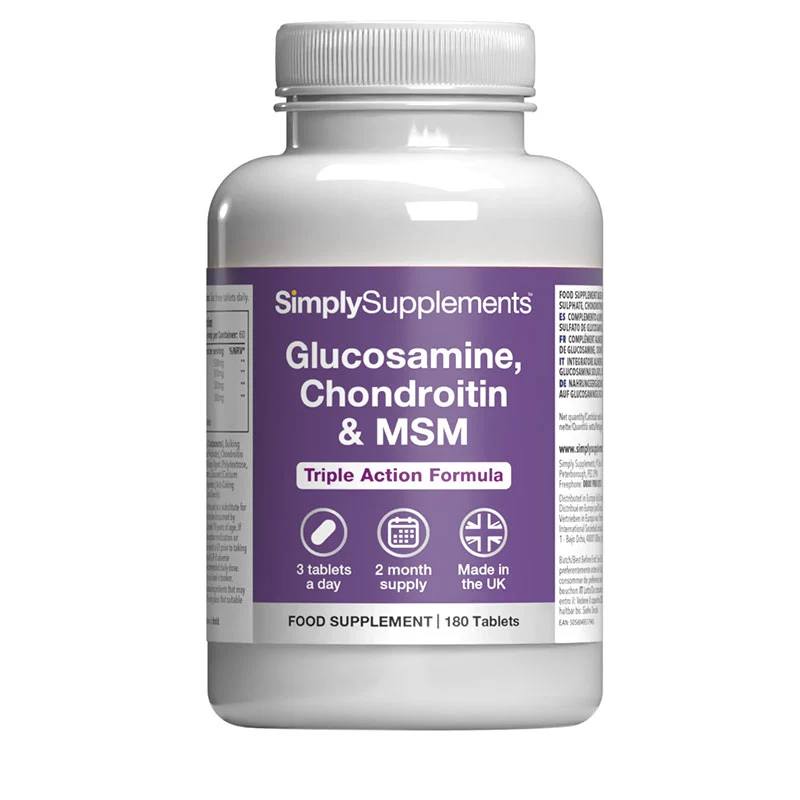
- Best for: anyone who wants glucosamine, chondroitin and MSM in one tablet
- Form: combination, glucosamine sulphate 2KCl with chondroitin sulphate and MSM
- Glucosamine per serving: 1,500mg glucosamine sulphate 2KCl (930mg glucosamine base), plus 300mg chondroitin sulphate (90% purity) and 300mg MSM, across three tablets
- Servings: 180 tablets, 60 servings
- Price: £22.99 per tub, £20.69 on subscription
- Our verdict: the combination’s best result comes from a subgroup its own authors called preliminary
Check today’s price at Simply Supplements
Glucosamine 500mg, Chondroitin 100mg and MSM 100mg Tablets is the most expensive serving here: £22.99 across 60 servings is 38.3p, £20.69 on subscription is 34.5p. Item 2 gives the same 60 servings at 5.3p, roughly seven times less for the same daily glucosamine.
In GAIT (Clegg et al., NEJM 2006), across 1,583 knee osteoarthritis patients over 24 weeks, the combination showed no significant difference from placebo overall. In the pre-specified moderate-to-severe pain subgroup, 79% on the combination achieved a 20% or greater pain reduction against 54% on placebo, though the authors called that preliminary given the subgroup’s size. ACR with the Arthritis Foundation (2019) and OARSI (2019) both recommend against chondroitin specifically.
There is a dose gap too: GAIT used 1,200mg of chondroitin a day, this product provides 300mg per serving. No trial evidence for MSM appears in the research reviewed, and the “highest levels of chondroitin purity (90%)” and “synergistic trio” lines are the manufacturer’s, not findings.
If your knee pain is moderate to severe and you want the combination the GAIT subgroup used, start here.
6. Vegan Glucosamine HCl 1000mg with Vitamin C 40mg: Best Vegan Formula
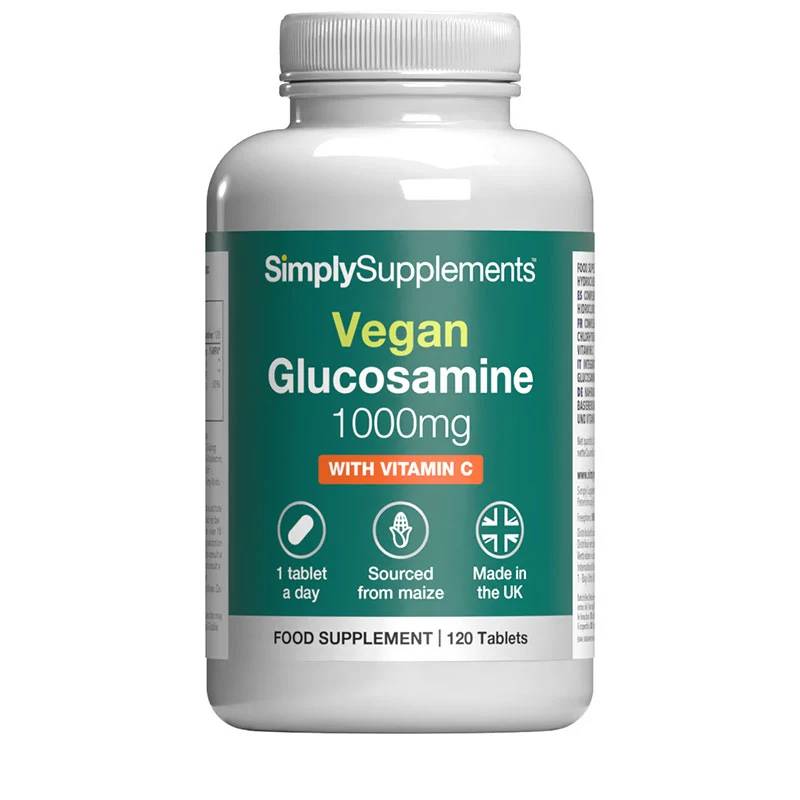
- Best for: vegans, vegetarians, and anyone avoiding shellfish-derived glucosamine
- Form: Glucosamine Hydrochloride (HCl), maize-sourced
- Glucosamine per serving: 1,000mg glucosamine hydrochloride (830mg glucosamine base) plus 40mg vitamin C (50% NRV) per tablet, one tablet daily
- Servings: 120 tablets (about four months) or 240 tablets
- Price: £19.29 for either pack size
- Our verdict: the only fully vegan option here, and the larger pack is the obvious buy
Check today’s price at Simply Supplements
Same price, twice the tablets: both the 120-tablet and 240-tablet packs of Vegan Glucosamine HCl 1000mg with Vitamin C 40mg are listed at £19.29, putting the smaller at 16.1p a serving and the larger at 8p, verified live on 22 September 2026 and subject to change.
Hydrochloride carries more glucosamine per milligram of salt: 830mg of base from this 1,000mg tablet, against 888mg from item 1’s 1,500mg tablet. Sulphate has the better pharmacokinetic showing, covered in the form comparison below.
Vitamin C is a supporting act: it has a recognised role in normal collagen formation, which is relevant to cartilage, but no direct evidence ties it to joint outcomes in the sources reviewed. For anyone with a shellfish allergy history, the Anaphylaxis Campaign advises shellfish-free preparations, which is this product’s case over the marine options.
7. Quick Release Glucosamine 65 Plus: Best for an active lifestyle over 65
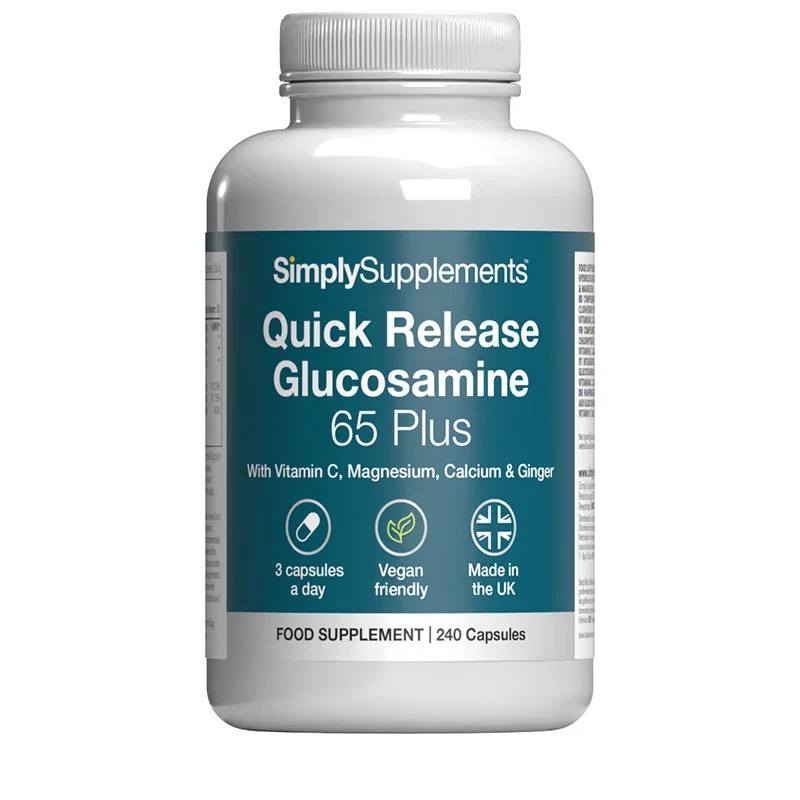
- Best for: over-65s who want joint, bone and muscle support in one product
- Form: vegetarian Glucosamine Hydrochloride (HCl), two-piece capsule that can be opened onto food
- Glucosamine per serving: 1,125mg glucosamine hydrochloride (933.75mg glucosamine base) across three capsules, plus ginger root extract (1,500mg equivalent from 75mg of a 20:1 extract), 90mg vitamin C, 150mg calcium and 150mg magnesium
- Servings: 240 capsules, three capsules per serving
- Price: £14.39 on sale, was £23.99
- Our verdict: a well-stocked formula, with one label claim that does not survive contact with the trial data
Check today’s price at Simply Supplements
Does “quick release” mean anything for a supplement judged over months? Quick Release Glucosamine 65 Plus delivers 933.75mg of glucosamine base per serving, ahead of item 6’s 830mg and second only to item 3’s 1,100mg.
Calcium and magnesium are the genuine over-65 angle: both have a recognised role in maintaining normal bones, and magnesium in normal muscle function. Neither has a joint benefit to claim. Ginger root extract is commonly included for joint comfort, but no trial evidence for it in osteoarthritis at this dose appears in the research set, and vitamin C carries the same collagen hedge as item 6.
“Fast-acting” is the manufacturer’s description; the trials showing benefit ran six months or longer. Three capsules a serving makes 240 capsules 80 servings, so £14.39 is 18p a serving, verified on 22 September 2026. The pre-sale £23.99 would be 30p, so expect a revert.
How we chose the best glucosamine supplements
Most buying guides grade products without showing their working.
- Glucosamine form. Sulphate 2KCl or hydrochloride, the first filter, compared in full below.
- Glucosamine base per serving, not salt weight. The spread across this roster runs 592mg, 830mg, 888mg, 930mg, 933.75mg and 1,100mg.
- Additional ingredients, and whether a studied dose is present. Item 5 carries 300mg of chondroitin against GAIT’s 1,200mg a day.
- Dosage format. One tablet against three, capsule against tablet, and whether the capsule opens.
- Cost per serving. List price divided by servings per pack, shown in every review above.
- Label transparency. Whether the glucosamine base figure is printed alongside the salt figure.
- Ease of use. Tablet size, daily tablet count, openable capsules.
- Dietary suitability and allergens. Marine against maize-sourced, and vegan or vegetarian status.
Products were assessed from label and specification data published on the retailer’s own product pages, verified live on 22 September 2026, alongside the published clinical evidence cited throughout. No first-hand testing was carried out and none is claimed.
What is glucosamine and how does it support joint health?
Two numbers appear on most glucosamine packs, and only one of them is the dose.
Glucosamine is an amino sugar the body produces naturally and a building block for the glycosaminoglycans that make up the cartilage cushioning your joints, according to NCCIH and Harvard Health. Arthritis UK describes glucosamine sulphate as supporting healthy cartilage and joint structures. It is not described as rebuilding or repairing them.
Supplement glucosamine comes from shellfish shells, as in items 1 to 5, or from maize and corn fermentation, as in items 6 and 7. The NHS covers where glucosamine sits among osteoarthritis treatments, alongside exercise and weight management for joint health more broadly.
What is glucosamine sulphate?
Glucosamine sulphate is glucosamine bound to a sulphate molecule and stabilised with a mineral salt, usually potassium chloride, which is what “2KCl” on a label means. That salt is why 1,500mg of glucosamine sulphate 2KCl delivers 888mg of glucosamine base, and the base figure is the one worth comparing. Retailers and manufacturers push opposite conclusions on which form is superior, leaving buyers guessing.
Glucosamine sulphate vs glucosamine hydrochloride: Which form is better?
The form comparison may be the wrong argument: the trials that worked used a grade of material you cannot buy off a shelf. The evidence leans towards sulphate without being conclusive, and formulation grade appears to matter more than the sulphate against glucosamine hydrochloride distinction itself.
| Measure | Glucosamine sulphate 2KCl | Glucosamine hydrochloride |
| Glucosamine base per 1,000mg of salt | About 592mg | About 830mg |
| Median oral bioavailability | 9.4% | 6.1% |
| Synovial fluid concentration at equal dose | Significantly higher (as branded Dona) | Lower |
| Trial evidence base | Larger, and the positive long-term trials used it | Thinner, more neutral findings |
| Typical source | Shellfish shells (marine) | Maize fermentation |
| Suitable for vegans and shellfish allergy | Rarely | Usually |
| Example in this guide | Items 1 and 3 | Items 6 and 7 |
One caveat is usually dropped: the plasma bioavailability difference did not reach statistical significance. The synovial fluid difference did.
A Cochrane review tied the most favourable trial results to the prescription-grade crystalline glucosamine sulphate preparation rather than to glucosamine as a class. That reaches us through a secondary summary, not a direct Cochrane Library fetch, and patented crystalline glucosamine sulphate is not a generic over-the-counter tub, so the findings do not transfer automatically to anything in this guide.
Hydrochloride’s counterpoint is real: more base per milligram of salt, which is why item 6’s 1,000mg tablet delivers 830mg while item 1’s 1,500mg tablet delivers 888mg.
What should you look for in a glucosamine supplement?
Seven checks, usable at any retailer, about a minute per product.
1. Form: sulphate or hydrochloride
The evidence leans towards sulphate; hydrochloride is the route for vegans and anyone avoiding shellfish. Pick your form first.
2. Glucosamine base per serving, not salt weight
Aim for the 1,500mg of glucosamine sulphate 2KCl, around 888mg of base, that the trials used. Items 1, 2, 3 and 5 clear it; item 4 does not.
3. Capsules or tablets
Tablet size is the most common reason people stop taking glucosamine. Items 4 and 7 open onto food, so filter on format first and dose second if swallowing is a problem.
4. Additional ingredients
Chondroitin, MSM, vitamin C, ginger, calcium and magnesium all turn up in joint formulas. Ask what dose is present and whether anyone has studied it: item 5 has 300mg of chondroitin against GAIT’s 1,200mg a day.
5. Cost per serving, not pack price
Item 2 is £3.17 per tub for 60 servings, 5.3p each; item 5 is £22.99 for the same 60 servings, 38.3p. Divide price by servings before comparing.
6. Brand transparency
Check whether the label states the glucosamine base figure separately from the salt figure. A pack that prints only the larger number has told you something.
7. Allergens and dietary requirements
Marine glucosamine is shellfish-derived; items 6 and 7 are maize-sourced, and UK-licensed glucosamine medicines contraindicate shellfish allergy.
Match the product to how you live. A once-daily tablet beats a three-a-day regimen you will forget by Wednesday.
Glucosamine and chondroitin: What’s the difference?
No, they are not the same thing. Glucosamine is an amino sugar that acts as a building block for the glycosaminoglycans in cartilage. Chondroitin is a complex carbohydrate and a structural cartilage component that gives it resistance to compression, according to NCCIH and Harvard Health. They are sold together because both are theorised to protect chondrocytes and to have anti-inflammatory properties.
Are glucosamine chondroitin supplements worth the extra cost?
The evidence bases differ, and the guideline position on chondroitin is the harder of the two: ACR with the Arthritis Foundation (2019) and OARSI (2019) both recommend against chondroitin for knee osteoarthritis, citing low-quality evidence. Item 5 is the combination product here, and it provides 300mg of chondroitin per serving against the 1,200mg a day used in GAIT.
A dedicated glucosamine and chondroitin comparison will follow.
Are glucosamine supplements worth taking?
The evidence is genuinely mixed, and UK national guidance is against it.
NICE guideline NG226, published 19 October 2022, states: “Do not offer glucosamine or strong opioids to people to manage osteoarthritis.” Patients who ask about it should be told there is no strong evidence of benefit. CG177 (February 2014) said: “Do not offer glucosamine or chondroitin products for the management of osteoarthritis”, so the position has held since 2014. The NHS states: “GPs no longer prescribe chondroitin and glucosamine on the NHS because there’s no strong evidence that they are effective as a treatment.”
GAIT (Clegg et al., NEJM 2006) put 1,583 knee osteoarthritis patients on glucosamine 1,500mg, chondroitin 1,200mg, both, celecoxib or placebo for 24 weeks. Celecoxib beat placebo, about 70% against 60% reaching a 20% pain reduction; glucosamine, chondroitin and the combination did not. Wandel et al. (BMJ 2010;341:c4675) found no pain reduction and no effect on joint space narrowing.
The other side is not empty. Arthritis UK reports seven of 13 placebo-controlled trials favouring glucosamine sulphate over placebo for pain. A 2023 systematic review found global pain on a visual analogue scale significantly reduced (weighted mean difference -7.41, 95% CI -14.31 to -0.51) while the WOMAC pain subscale was not (-0.04, 95% CI -0.13 to 0.06), so the benefit depends on the measure used.
Expert bodies split. ACR with the Arthritis Foundation (2019) strongly recommends against glucosamine; AAOS (2021) calls it a supplement that “may be helpful” for mild-to-moderate knee osteoarthritis on inconsistent evidence. Most positive trials used patented crystalline glucosamine sulphate rather than generic material, a probable explanation, though a secondary synthesis rather than a primary finding. NCCIH reports inconsistent results for glucosamine sulphate in osteoarthritis.
Speak to a GP or pharmacist before starting, particularly if you take other medication. Glucosamine is no substitute for the exercise and weight management NICE does recommend.
How to take glucosamine: Dosage, Timing and how long a pack lasts
The standard dose is settled, even if its effect is not. Across the major trials it was 500mg of glucosamine sulphate three times daily, or a single 1,500mg once-daily dose, the glucosamine arm of GAIT. Follow the label.
| Product | Daily serving | Pack lasts |
| 1. Sulphate 1,500mg Tablets | One tablet | 180 days |
| 2. Sulphate 500mg | Three tablets | About two months |
| 3. Max Strength 1858mg 2KCl | Two tablets | 90 servings |
| 4. Sulphate 1,000mg Capsules | One capsule | Six months |
| 5. Glucosamine, Chondroitin and MSM | Three tablets | 60 servings |
| 6. Vegan Glucosamine HCl 1000mg | One tablet | About four months (120 tablets) |
| 7. Quick Release 65 Plus | Three capsules | 80 servings |
Pack size is a poor guide: two of those tubs hold 180 units and last two months and six months. With food is the usual label instruction, and the answer if supplements unsettle your stomach. Items 4 and 7 open onto food.
Consumer guidance commonly suggests four to eight weeks before deciding whether joint stiffness or pain has eased. That is guidance, not a clinical finding: the trials showing benefit ran at least six months, the strongest from 36-month trials (Pavelka 2002, Reginster 2001).
Glucosamine safety and side effects: Who should avoid taking glucosamine?
Most labels say “consult your doctor” without saying what the concern is.
Glucosamine is generally well tolerated. The 2023 systematic review found no serious adverse events, adverse event rates not meaningfully different from placebo, and gastrointestinal effects, most often diarrhoea. One consumer reported only more frequent diarrhoea after two months on glucosamine hydrochloride with chondroitin.
Shellfish allergy. The mechanistic risk looks low: the allergen is an IgE reaction to proteins in shellfish flesh, not the shell glucosamine comes from, and no reports of reactions in shellfish-allergic patients appear in the literature reviewed. Even so, every UK-licensed glucosamine medicine (Alateris, Dolenio, Glusartel, YOINTY) contraindicates it on its Summary of Product Characteristics, and the Anaphylaxis Campaign advises shellfish-free preparations. Items 6 and 7 are maize-sourced.
Anticoagulants. The firmest warning here. The FDA’s MedWatch database holds 20 reports of altered coagulation, raised INR and increased bleeding or bruising, in patients combining warfarin with glucosamine or glucosamine-chondroitin. The MHRA advises warfarin users to avoid glucosamine; case reports recommend INR monitoring where it is used.
Diabetes. The received wisdom is largely wrong. A controlled study of 14 subjects taking 500mg three times daily for four weeks found no change in fasting glucose, insulin, lipoproteins or insulin sensitivity, whatever their BMI or baseline glucose tolerance. The animal studies behind the concern used intravenous doses 100 to 200 times typical oral human doses, and a meta-analysis with Mendelian randomisation found an association with lower type 2 diabetes risk, though that is observational rather than causal. Caution is still commonly advised.
Pregnancy and breastfeeding. Not recommended due to insufficient safety data. Check with a pharmacist before starting if you take any regular medication.
Our verdict: The best glucosamine supplements overall
The answer in five lines.
- Best overall: Glucosamine Sulphate 1,500mg Tablets, the trial-matched 1,500mg 2KCl dose in one daily tablet.
- Best value: Glucosamine Sulphate 500mg, the same daily dose at the lowest cost per serving here, if three tablets a day suit you.
- Best glucosamine sulphate option for maximum strength: Max Strength Glucosamine Sulphate 1858mg 2KCl, with the caveat that no trial supports dosing above 1,500mg.
- Best combination formula: Glucosamine 500mg, Chondroitin 100mg and MSM 100mg Tablets.
- Best vegan and shellfish-free option: Vegan Glucosamine HCl 1000mg with Vitamin C 40mg.
NICE does not recommend glucosamine for osteoarthritis, so treat any of these as a personal trial, and speak to a pharmacist or GP first if you take other medication.
Glucosamine sulphate FAQs
Much depends on your own medication and circumstances, so treat these answers as a starting point.
What is glucosamine sulphate?
Glucosamine sulphate is an amino sugar bound to a sulphate molecule and stabilised with potassium chloride, shown on labels as 2KCl. It is sold as a joint supplement, and a 1,500mg dose of the salt delivers roughly 888mg of glucosamine base.
Does the NHS recommend glucosamine?
No. The NHS states: “GPs no longer prescribe chondroitin and glucosamine on the NHS because there’s no strong evidence that they are effective as a treatment.” Patients who want to keep taking it are directed to buy it over the counter.
Why do doctors not recommend glucosamine?
NICE concluded there is no strong evidence of benefit, in CG177 (2014) and NG226 (2022), supported by Wandel et al. (BMJ 2010), which found no reduction in pain or joint-space narrowing against placebo. AAOS (2021) takes a more permissive view, so this is disagreement, not unanimity.
Is glucosamine sulphate better than glucosamine hydrochloride?
The evidence leans towards sulphate but is not conclusive: median oral bioavailability of 9.4% against 6.1%, with higher synovial fluid concentrations at equal dose. A Cochrane review tied the best results to prescription-grade crystalline glucosamine sulphate specifically, not the sulphate form as a class.
Who should avoid glucosamine?
Anyone on warfarin or another anticoagulant without medical supervision, given MHRA advice and 20 FDA MedWatch reports of altered coagulation. Also anyone pregnant or breastfeeding, and anyone with a shellfish allergy who has not chosen a maize-sourced product. People with diabetes should tell their GP or pharmacist.
What is a good glucosamine supplement?
One that delivers around 1,500mg of glucosamine sulphate 2KCl a day, roughly 888mg of glucosamine base, in a format you will keep taking. Glucosamine Sulphate 1,500mg Tablets is the overall pick here, Glucosamine Sulphate 500mg the value one.
Can you take glucosamine if you are allergic to shellfish?
The allergen sits in shellfish flesh rather than the shell glucosamine comes from. Even so, UK-licensed glucosamine medicines contraindicate it, and the Anaphylaxis Campaign advises shellfish-free preparations. Items 6 and 7 are the maize-sourced options here; check with a pharmacist first.
How long does glucosamine take to work?
Consumer guidance commonly suggests four to eight weeks before judging whether it has helped. That is guidance, not a clinical finding: the trials showing any benefit ran six months or longer, with the strongest results from 36-month trials.
Sources
UK and clinical guidance
- NICE, NG226: Osteoarthritis in over 16s: diagnosis and management (2022)
- NICE, CG177: Osteoarthritis: care and management (2014, predecessor to NG226)
- NHS, Osteoarthritis: Treatment
- NCCIH, Glucosamine and Chondroitin for Osteoarthritis: What You Need To Know
- Arthritis UK (Versus Arthritis), Glucosamine
Trial and review evidence
- Clegg DO et al., “Glucosamine, Chondroitin Sulfate, and the Two in Combination for Painful Knee Osteoarthritis” (the GAIT trial), New England Journal of Medicine, 2006. nejm.org
- Wandel S et al., “Effects of glucosamine, chondroitin, or placebo in patients with osteoarthritis of hip or knee: network meta-analysis”, BMJ 2010;341:c4675. doi.org/10.1136/bmj.c4675
- Xu C et al., “Effectiveness and Safety of Glucosamine in Osteoarthritis: A Systematic Review” (includes the Fransen 2015, Pavelka 2002 and Reginster 2001 trial data cited throughout this guide), 2023. PMC10366893
- Towheed TE et al., “Glucosamine therapy for treating osteoarthritis”, Cochrane Database of Systematic Reviews, 2005. cochrane.org
- Kolasinski SL et al., “2019 American College of Rheumatology/Arthritis Foundation Guideline for the Management of Osteoarthritis of the Hand, Hip, and Knee”. PubMed
- Bannuru RR et al., “OARSI guidelines for the non-surgical management of knee, hip, and polyarticular osteoarthritis”, 2019. PubMed
- American Academy of Orthopaedic Surgeons, “Clinical Practice Guideline Summary: Management of Osteoarthritis of the Knee (Nonarthroplasty), Third Edition”, 2021. PubMed
- “Comparison of pharmacokinetics of glucosamine and synovial fluid levels following administration of glucosamine sulphate or glucosamine hydrochloride”, Osteoarthritis and Cartilage (OARSI journal). sciencedirect.com
Safety and interactions
- Knudsen JF, Sokol GH, “Potential glucosamine-warfarin interaction resulting in increased International Normalized Ratio: case report and review of the literature and MedWatch database”, Pharmacotherapy, 2008. PubMed
- GPnotebook, Glucosamine and warfarin (UK clinical summary referencing MHRA advice)
- Anaphylaxis UK (Anaphylaxis Campaign), Shellfish Allergy factsheet
- “The Effect of Oral Glucosamine Sulfate on Insulin Sensitivity in Human Subjects”, Diabetes Care, 2003. diabetesjournals.org
- “The effect of glucosamine on glucose metabolism in humans: a systematic review of the literature”, Osteoarthritis and Cartilage. sciencedirect.com
- Zhou S et al., “Glucosamine supplementation contributes to reducing the risk of type 2 diabetes: evidence from Mendelian randomization combined with a meta-analysis”, Journal of International Medical Research, 2025. PubMed
Retailer data
- Simply Supplements, Glucosamine collection. Product names, prices and specifications for all seven products reviewed above were verified live on 22 September 2026; individual product links appear at first mention throughout this guide.