





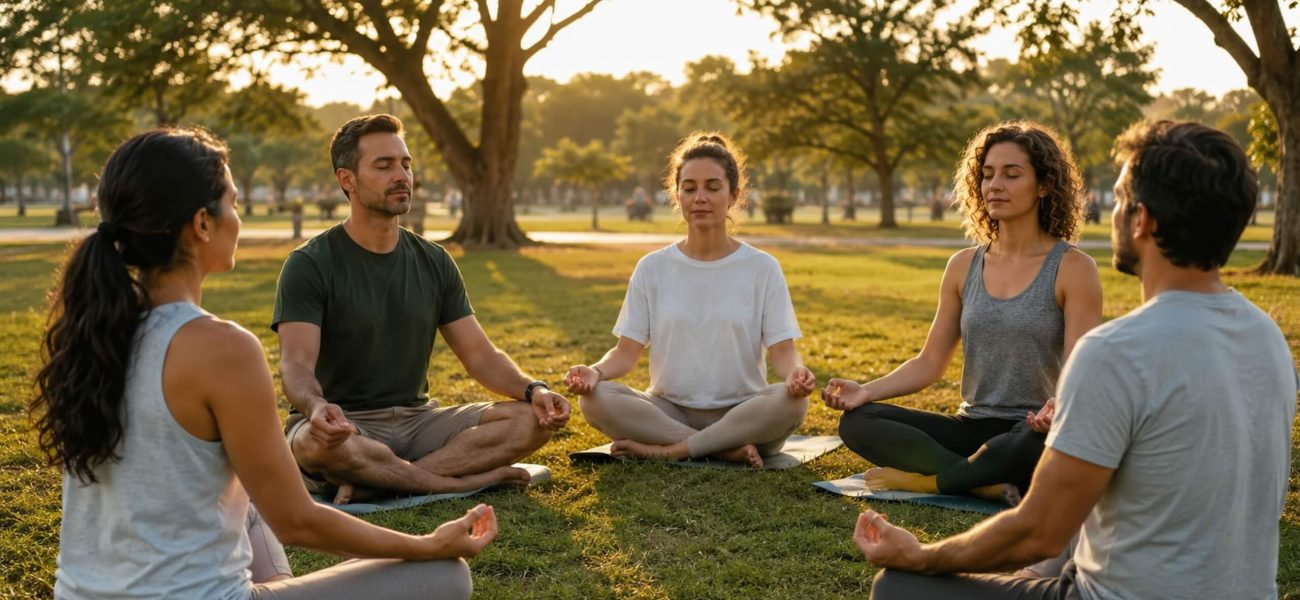

You bought the cushion. You downloaded the app. For a week, maybe two, you sat every morning and felt the small pride of a streak climbing. Then a hard Tuesday arrived, the streak broke, and the cushion slowly became a place to drop your keys. If that arc sounds familiar, you are in enormous company – and the missing piece may be other people. This is the quiet promise of group meditation: that a practice we usually treat as private gets steadier the moment we stop doing it alone.
Why solo meditation is so easy to abandon
If you have ever downloaded a meditation app, you already know how the story tends to go. The first few sessions feel promising. Then life crowds in – a late meeting, a sick kid, a stretch of bad sleep – and the practice slips to the back page of your phone, somewhere near the language app and the workout plan you also meant to keep.
It is tempting to call this a failure of discipline. It is closer to a feature of doing things alone. When a habit rests entirely on your own motivation, it has nothing to lean on when that motivation dips. And the research, while encouraging, is honest about its limits. The National Center for Complementary and Integrative Health notes that regular mindfulness practice may help some people with stress and sleep, though the evidence is still developing and the effects vary from person to person. What the studies rarely measure is the obstacle most beginners actually hit: not learning the technique, but remembering to return to it, day after day, when nothing outside of you is asking you to.
What changes when you meditate with others
Sit in a room where a few people are breathing in silence and the experience changes texture. The quiet feels less like an absence and more like something shared. There is a faint, almost physical sense of being carried by the group’s attention. And there is one thing a notification can never quite reproduce: someone is expecting you.
Accountability that feels like warmth, not pressure
Showing up for a group is a gentle kind of accountability. You are not feeding a streak or satisfying an algorithm; you are keeping a small promise to people who would notice the empty cushion. For a lot of people, that shift – from a private goal to a shared one – is exactly what turns a good intention into a habit that lasts. Group mindfulness runs on the same quiet logic as a running club or a book group: we keep doing the thing when someone is doing it beside us.
A sense of belonging
There is also the plain fact of being among people. The U.S. Surgeon General has issued an advisory on loneliness and social disconnection, drawing attention to its consequences for health. You do not need a clinical study to feel the pull of that; you have likely felt it yourself. A weekly gathering to breathe together is a low-stakes way to be in good company, and decades of research summarised by Harvard Health suggest that strong social ties are associated with greater wellbeing. The benefit of group meditation, in other words, is not only the meditating. It is the familiar faces.
“Decades of research summarised by Harvard Health suggest that strong social ties are associated with greater wellbeing”
From meditation apps to meditation community
None of this is an argument against technology. Meditation apps did something genuinely useful: they made the practice approachable for millions of people who would never have walked into a studio. The real question now is what we ask our phones to do next. A screen can keep you scrolling alone in the dark, or it can help you close the laptop and find a few neighbours who want to sit together on a Thursday evening.
That is the idea behind a small but growing category of tools built less for solo audio and more for in-person meditation. Rather than competing to be the most immersive set of headphones, they try to get you off the screen entirely. The Pinealage app is one example: instead of another library of guided tracks, it helps people find others nearby and form small, local groups that meet in everyday public spaces – a park at dusk, a quiet square, a community room that becomes a kind of refuge. You open it long enough to find your people, then put the phone away.
“We want to take apart the idea that meditation has to be a solitary battle,” says Gonzalo Arce, Pinealage’s founder and CEO. “We seek to normalise group meditation and turn it into a new social wellness habit.”
The aim is not to gamify stillness. It is to make a meditation community feel ordinary and within reach – to turn a private habit into a shared one, and to let the app fade into the background once the people are in the room.
How to find meditation groups near you
If solo practice has never quite stuck, the older, communal version is worth a try, and you can start small. Ask whether a local studio, library, or community centre hosts a sitting group; many run free or low-cost sessions and welcome complete beginners. A quick search for “meditation groups near me” will often surface in-person meditation groups and meetups you did not know existed nearby. Community boards and local listings can point you toward established circles, too.
And if you would rather meet a few like-minded people directly, a meditation app for groups can shorten the distance between a good intention and your first real session. However you get there, the aim is the same: to meditate with others in a way that feels human and sustainable, rather than one more task to optimise.
A quieter kind of progress
We pour a lot of our wellness energy into fixing ourselves in private. Maybe part of what we are looking for is older and simpler than any app – a few familiar faces, a shared silence, and a reason to come back next week. If that sounds like what has been missing, group meditation may be the gentlest place to begin.
You can learn more about finding small, in-person meditation groups through the Pinealage app.
FAQ
Is group meditation better than meditating alone?
Neither is inherently better; they offer different things. Solo practice gives you flexibility and privacy, while group meditation adds accountability, gentle structure, and a sense of belonging. Many people find that doing both – a short daily sit at home plus a weekly in-person session – helps them stay more consistent than either approach on its own.
Do I need experience to join an in-person meditation group?
Usually not. Most group mindfulness gatherings welcome complete beginners, and sitting alongside more experienced people can make the first few weeks feel less intimidating. If you are nervous, it is perfectly fine to introduce yourself as new and simply follow along.
How do I find a meditation group near me?
Start with local studios, community centres, and libraries, which often host regular sessions. Online community boards can point you towards existing circles, and apps built around in-person meditation rather than guided audio can help you discover small groups forming near you.
What are the main benefits of group meditation?
The most reported benefits are practical: consistency, a feeling of accountability that comes from other people expecting you, and a sense of belonging. Mindfulness practice itself may help some people with stress and focus, though effects vary from person to person.
How is a meditation community app different from a regular meditation app?
A typical meditation app centres on guided audio you listen to alone. A meditation community app is built to get you off the screen – it helps you find others nearby and meet in person, so the app is the doorway rather than the destination.